

The Fiduciary State: Re-writing Government as enforceable legal Contracts for management of countries for and on behalf of us, the people.
Would you trust someone to CLEAN YOUR HOUSE, on the basis that they had
NO duty to do so, and
NO liability for anything they do?
Even if they SELL YOUR BELONGINGS?
If they sold your stuff, they would NOT go to jail, and you would NOT get your belongings back?
So WHY do we TRUST and give IMMUNITY FROM THE LAW, to people we employ to run our countries?
They would be FOOLS not to enrich themselves.
The answer is simple and unavoidable: REMOVE THE IMMUNITY
— from the laws, duties and personal liability that apply to EVERY OTHER PERSON
— company officers, lawyers, doctors, engineers, accountants, trustees, agents, employees, parents, and cleaners.

This can be achieved very simply. By passing a simple piece of legislation by a simple parliamentary majority, repealing all Court-invented immunity of politicians, candidates and state officials from the law including fraud, contract, tort and equity particularly unjust enrichment and fiduciary duties under the general law; also removing all restrictions on appeal and judicial review of their actions and omissions.
It is self-entrenching. Any attempt to legislate immunity in the future, either by legislature, administration or courts, would be itself a breach of fiduciary duty, triggering injunction, removal for breach of contract and personal legal liability of every individual involved.
Then, instead of being controlled by self-interest and dark money, they will be controlled by the law.
🚨 If politicians can
💣 lie to get votes (fraud),
💣 break election promises (breach of contract)
💣 shut out and destroy citizens and the public estate to selectively enrich (breach of fiduciary duty)
… then
💥 WE DON’T HAVE REPRESENTATIVES
💥 WE DON’T HAVE DEMOCRACY
💥 WE HAVE SHORT TERM DICTATORSHIPS BY WHOEVER CONTROLS THOSE POLITICIANS.
Contents
What we are angry at is not “democracy”. We are angry at the complete lack of it.
3. The Specious Defenses of Immunity (And the Athenian Reality)
We are told we live in the golden age of democracy. We are instructed, from childhood, that the right to vote once every three or four years makes us the masters of our political destiny.
But look closely at the global landscape. Western societies are fractured by a deep, boiling fury.
The media characterizes this as an “anti-democratic” wave—a dangerous populism where the public is ready to tear down the institutions of liberty.
Actually, people are right to want to tear down the institutions which rule us, against our will. But what we have been told, that those institutions are democracy and liberty, is a profound lie.
What we are angry at is not “democracy”. We are angry at the complete lack of it.
We have been handed a counterfeit system and told it is the genuine article.
BUT, In their justified rage, people are being misled by this lie, into throwing the baby out with the bathwater—abandoning the very idea of self-government because we are told it’s our fault and it can never work - while what we have been sold is nothing more than a front for a corporate cartel.
What we call “modern democracy” is not a democracy at all. It is a system of short-term elected dictatorships. And the concrete foundation keeping this tyranny in place is a single, toxic legal doctrine: Blanket Political Immunity.
Worse still, that lie is being used to sell people real dictatorship
- “strong man” right wing who stir up hate and fear, falsely blaming innocent victims like immigrants, minorities and the poor; and make empty promises to cure the problems then grab power - just like Hitler and Mussolini, Putin, Erdogan, Orban and Trump did;
- or worse still, the extractors themselves, the Musks and Thiels, pushing for abolition of even the limited control of elections, to rule directly and permanently, while they surreptitiously suck our wealth, our data, our privacy and our freedoms, gaining complete control over every individual’s very life.
The incredible, terrifying part is that so many people are so confused and exhausted by the fire-hose of disinformation that they actually fall for it.
1. The Great Bait-and-Switch: The Illusion of Suffrage
To understand how we arrived here, we must unlearn centuries of astro-turfed historical narrative.
The standard history textbook claims that the story of the last 300 years is one of expanding liberty: the hard-fought march toward universal suffrage, where every adult finally gained the right to vote.
But this narrative conceals a brilliant, cynical maneuver. The creation of universal suffrage by one hand was quietly accompanied by the removal of any actual meaning of suffrage by the other.
When the wealth extraction network (who called themselves “Aristocrats” and “Nobility” — recently less flatteringly termed the “Epstein class”), who had taken almost all of the land and resources through centuries of exploitation and oppression of the rest of the population, realized they could no longer prevent the masses from voting, they didn’t surrender power. Instead, they re-engineered the state so that it didn’t matter who the “masses” voted for. They decoupled the vote from the exercise of power by implementing two structural features:
No Legal Requirement to Represent: In virtually every modern “representative” system, a politician is under zero legal obligation to fulfill their campaign promises, uphold their policies, or represent the interests or instructions of their constituents. Their election platform is “non-binding marketing.” In plain language, a confidence trick. Legalised fraud.
Absolute Legal Immunity: This insures politicians, officials and judiciary against the real-world consequences of their decisions.
By separating the politicians and officials from any legal liability, the state ceased to be a representative body. It became a revolving short-term dictatorship. For a fixed term of years, the winning party commands total sovereign power over the country and people; they are kings, free to lie, extract wealth, and damage sectors of society, and literally commit crimes, with complete legal impunity.1
(↑ 1 minute short: $1m buys an awful lot of advertising — enough to win elections?
Like and share on YouTube! A downloaded copy is in the footnote2.)
2. The Swiss Variation of the Farce
When confronted with the failures of the Anglo-American systems, political scientists often point to Switzerland as the gold standard of direct democracy. With its citizen referendums and seven-member “consensus” cabinet, it is marketed as the ultimate alternative.
But the Swiss system is merely a highly sophisticated variation of the same farce.
While the Swiss public possess two vital tools, (essential to but not constituting, any real democracy)—the power to veto specific laws via referendums, and the power to force constitutional amendments by petition and majority referendum3 —the executive structure itself remains an insulated cartel. The seven-member Federal Council operates on the “Magic Formula,” a grand coalition that permanently divides the cabinet seats among the four largest rival parties.
This is marketed as “stability,” but functionally, it creates a system of institutionalized collusion. Because every major party is inside the executive room simultaneously, true opposition is strangled. The parties share a collective interest in maintaining the status quo and protecting their collective Ministers and sponsorships.
More importantly, Switzerland shares the exact same fatal flaw as the rest of the world: the seven ministers have personal immunity for their policy actions. If a Swiss councilor pushes a disastrous regulatory framework that cripples an economic sector, or facilitates and blocks recovery of funds obtained by crimes, they cannot be sued, removed, or held criminally liable.4 The public can kill the law, (if they can convince the majority, and the cantons) but the politicians remain safe in their seats, protected by their parliamentary peers. It is a more polite, consensual cartel, but it is a cartel nonetheless.
3. The Specious Defenses of Immunity (And the Athenian Reality)
The standard excuses provided by constitutional lawyers to justify political immunity are specious, unsupported by any empirical evidence5, and entirely contrary to history. They are myths, invented by vested interests to legalise corruption and incompetence, to weaken governments to the point they are unable to control the vested interests or protect their countries and people.
“The Symptoms are the Cause”
Everywhere we are distracted. “Money in politics” is a symptom of corruption, not the cause. The invention of a “Right to Lie” and the resultant fire-hose of disinformation chaos is another symptom.
Immunity — from the law, fiduciary duty and personal liability that applies to every other person in a position of trust, protecting us from grift — is the cause. Immunity enabled the introduction of those corruptions, and the inaction which allows them to continue, ignoring centuries of public demands.
Those symptoms and the corruption will keep coming back until immunity is gone.
The Myth of “Paralysis”
The primary defense of immunity is that “without it, governance would grind to a halt”. We are told that if politicians faced personal liability, they would be too terrified to act, paralyzed by the fear of being sued or jailed by political rivals for every complex decision.
This argument is flatly contradicted by 1. history and 2. the present.
To deal with 2. first: Companies are not paralysed. Their management, lawyers and accountants are all personally liable. They are not paralysed. If they don’t produce results, they are sacked.
But in case that is not enough,
The ancient Athenians invented democracy, and they ran it for nearly two centuries without a shred of political immunity.
In Classical Athens, governance carried real responsibility. Under the mechanisms of euthynai (end-of-term financial and political audits) and graphe paranomon (the right to prosecute any citizen who proposed an illegal or disastrous law), administrators and generals were personally on the hook for the outcomes of their decisions.6 If an Athenian leader carried out a military campaign that ended in negligent slaughter, or an economic policy that verged on malpractice, they faced financial ruin, exile, or execution. (The citizens directly voted on legislation, in 44 sessions a year. In modern society, citizens could effectively constitute an “upper house” of Parliament, voting electronically to approve legislation passed by Parliament. But that is a separate topic.)
Did this cause paralysis? Absolutely not. Once they had real power to control their state, citizens rapidly became politically literate, interested and aware of what should and should not be done. Athenian leaders could not sit on their hands. In fact, the system incentivised highly calculated, hyper-competent action, because inaction or cowardice in the face of a crisis was just as actionable as a bad decision. Much like modern day boards of directors.
The standard defence of immunity claims it prevents paralysis, but the opposite is true: immunity explicitly licenses inaction. Under current systems, the safest career move for a politician is to ignore structural crises—like housing affordability or infrastructure decay—and kick the can down the road, because maintaining a broken status quo keeps donors happy and carries zero personal risk.
The Myth that fiduciary democracy would be unpredictable, bad for businesses and cause money flight
This is the ultimate scare tactic the extraction cartel uses whenever their monopoly on power is threatened. They love to claim that if the “mob rules”, the economy will self-destruct, capital will flee the country overnight, and markets will collapse from “unpredictability.”
It is the exact economic equivalent of the “tyranny of the majority” myth—a narrative designed to make you panic and hand the keys back to the grifters.
In reality, a contract-based fiduciary democracy is the single best thing that could ever happen to legitimate, productive businesses. Here is how you dismantle that myth completely.
1. The Pro-Business Shield: Legitimate Wealth vs. Extractive Plunder
To debunk this, you have to separate the business world into two entirely different categories: Productive Enterprise and The Extractive Cartel.
The Extractive Cartel (The Whiners): These are the mega-corporations, hedge funds, and defense contractors whose entire business model relies on backroom political favors, corporate subsidies, tax loopholes, and regulatory capture. They hate fiduciary liability because they lose their ability to bribe an immune politician into writing a corrupt, anti-competitive law, and to stop officials from enforcing regulations protecting the community and real businesses.
Productive Enterprise (The Real Economy): These are the manufacturing plants, technology companies, food providers, local builders, and service providers who make real things and solve real problems, the real innovators, inventors and entrepreneurs; who are bought out or shut down by monopolies. They love true accountability, predictability, a level playing field, and transparent regulations they can work with.
A contract-based fiduciary democracy is the single greatest catalyst for legitimate, productive economic growth benefiting real businesses.
Fiduciary democracy doesn’t hurt business; it rescues honest businesses and the real economy from the threats from corrupt, politically protected cartels. When personal liability becomes the law of the land, politicians and officials are freed to promote real market freedom and functionality, a major factor for the success and prosperity of the whole community.
In the current corrupt environment, even a well-intentioned politician or official is often trapped—forced to play ball with powerful cartels and donor networks just to survive the political machine. Under a fiduciary model, the law of the land gives them the ultimate shield to say: “I cannot grant you that corrupt monopoly or backroom subsidy, because doing so would violate my contract and make me personally liable.”
2. The Truth About “Predictability”
The extractor class claims that a direct, liable democracy would be a chaotic rollercoaster of shifting laws. But look at the modern representative system: it is the absolute definition of chaotic unpredictability.
Every four to eight years, an election swings power to the opposite faction. Overnight, entire regulatory frameworks are torn up, tax codes are radically rewritten, and massive public projects are canceled mid-sentence just to spite the previous administration. Legitimate businesses are forced to burn billions on compliance, legal advice, and defensive lobbying just to survive the political whiplash. If they can survive it. Many don’t, and their businesses are picked up as bargains by the monopolies.
Under a contract-based fiduciary model, stability is hardcoded into the system:
The Data Safeguard: A politician can no longer pass an erratic, knee-jerk law based on a midnight ideological whim or a donor’s request. To pass any policy, they must publish clear, empirical impact data.
The Judicial Gatekeeper: If a policy is reckless, lacks data, or violates fundamental contract terms, the fiduciary court strikes it down.
This creates a hyper-stable environment where businesses can plan decades into the future, knowing that the rules of the game can only change if there is an unassailable, data-backed consensus.
3. Capital Flight: Where Are They Going to Go?
The threat of “capital flight” is a toothless bluff. The extraction cartels want you to believe that if you regulate them or demand accountability, they will pack up their factories, digital infrastructure, property holdings and consumer markets and move them to a tropical island.
But capital doesn’t invest in a country because its politicians have immunity; capital invests because of infrastructure, stability, and rule of law.
If a nation offers a clean, non-corrupt legal system, high-speed infrastructure, an educated workforce, and a transparent market free from arbitrary political interference, capital will flood into that country, not out of it.
The only money that flees a fiduciary democracy is dirty, extractive capital that can only survive in a rigged market. Good riddance. The vacuum they leave behind is instantly filled by honest, productive investors who are thrilled to operate in a market where the rules are transparent and cannot be bought. Not to mention the loyalty factor - many business owners want to see their home country flourish — more prosperity in the people means more custom for businesses.
4. The Astro-Turf Double Standard
The final irony of this myth is that the corporate world already operates under strict fiduciary liability every single day.
If the board of directors of a major publicly traded corporation acts with gross negligence, hides financial data from shareholders, or cooks the books to enrich themselves, they don’t get immunity. They get sued into oblivion by their shareholders, face massive class-action lawsuits, and get indicted by the SEC or equivalents.
Does this personal liability cause corporations to freeze up, become unpredictable, or trigger a mass exodus of executives? No. It is the exact mechanism that gives global investors the confidence to pour trillions of dollars into the stock market. They know the managers face real-world consequences if they commit fraud.
If fiduciary liability is the gold standard for creating trust, predictability, and wealth in the global corporate market, there is absolutely no rational reason it wouldn’t do the exact same thing for the state.
(More debunking of fake arguments to come: see below, click the back button to return to here)
THIS is what out of control governments lead to:
4. The Blueprint: Contract-Based Governance
To rescue democracy, we must replace the model of “parliamentary immunity” with a model of fiduciary liability.
We must treat public office exactly like any other high-stakes employment.
In a Contract-Based Governance System, running for office means applying for a professional position under a binding, legal employment contract. The architecture operates through four logical pillars:
A. The End of Self-Policing
If a legislature commands a clear majority, or if parties collude, they will always vote to protect their own. Therefore, the mechanism for holding politicians liable must be completely externalized. Liability, breach of contract, or negligence claims are ultimately appealed to an independent, citizen-led Constitutional Court, entirely insulated from parliamentary votes and appointments.
B. Radical Transparency as a Legal Obligation
Cabinet secrecy and legislative confidentiality are legally reclassified as tools for concealing negligence or fraud. All expert advice, data streams, impact assessments, and dissenting opinions must be published to the public in real-time. If a politician attempts to suppress data to favor a donor, it is treated as a criminal breach of contract7.
What secrecy enables: The US senate oversight committee hearing of new evidence still coming to light on CIA MK Ultra crimes against humanity — domestic and international:
C. The Procedural Shield for Honest Actors
Opponents claim a liability system would destroy honest politicians. On the contrary, it provides them with an unassailable legal shield: compliance and disclosure. Just as a surgeon protects themselves from malpractice suits by following medical protocols and obtaining informed consent, a competent politician protects themself through total transparency. If a politician discloses all risks, consults the public, and acts on the explicit instructions and mandates of the electorate, they carry zero personal liability if an unpredictable event ruins the policy outcome. The paper trail proves they acted with due diligence.
D. Actionable Malpractice vs. Ideology
Politicians would not be sued for honest disagreements. They could only be sued under the legal equivalent of corporate law’s Business Judgment Rule. A fiduciary court would only penalize a politician if it is proven they acted with gross negligence, ignored clear expert warnings, lied to the public about the facts, or acted under a conflict of interest to extract wealth for private benefit.
5. The End Result: A Lean, Clean, and True Democracy
What happens to a society when you strip away the protective shield of immunity and enforce a contract-based state? The entire incentive structure of civilization shifts for the better.
1. A Drastic Reduction in the Cost of Government
The vast majority of national debt and government waste is not accidental; it is the result of legal corruption. When politicians face no personal liability, they routinely approve bloated infrastructure projects, corporate bailouts, and inefficient bureaucracies designed to funnel public money into the pockets of private cartels.
When politicians face personal financial ruin for approving fraudulent or grossly negligent expenditures, the cost of government evaporates. Bad actions are stopped before they start because the financial risk to both the politician and the corporate beneficiary becomes catastrophic. The state treasury is no longer treated as a pirate ship to be plundered.
2. A Complete Cleanse of the Talent Pool
The current lack of liability acts as a filter that attracts the worst elements of society: grifters, demagogues, narcissists, and wealth extractors. These are individuals who excel at optics and backroom networking, thriving in a culture where they can socialize losses and privatize gains. Highly ethical, competent professionals refuse to enter this toxic arena because they know the corrupt culture will isolate, block and discredit them.
If political office carried the exact same civil and criminal risks as being any neurosurgeon, engineer, lawyer, agent, trustee, or company officer, the grifters would flee the field overnight. The prospect of a prison sentence or personal bankruptcy for suppressing the truth or enriching a donor would make the job completely unappealing to them.
The field would be left open to risk-aware, highly competent, and honest administrators and prudent, ethical, conscientious legislative representatives. These individuals are already perfectly comfortable working under strict, measurable legal contracts because they have nothing to hide.
No managed lustration will be required. The genuine, dedicated politicians and officials who have nothing to hide will stay, glad of the opportunity to properly do their jobs, finally achieve what they want without obstruction and attacks, and to get credit for it. Bad actors will quietly disappear when faced with the disinfectant of transparency.
Conclusion: Reclaiming Our Countries — and Our Lives
We must stop blaming “democracy” for the corruption of our world. We do not live in a democracy; we live in an engineered immunity trap designed to license equity destruction and wealth extraction for a shadow kleptocracy.
The path forward does not require us to abandon the vote; it requires us to make the vote effective. The vote is how we decide whom we employ - just like companies do - shareholders elect directors, directors vote to appoint management.
It’s the middle way between uncontrollable entrenched dictators (controlling an illusion of government), and the radical Athenian appointment of random citizens by lottery to administer the state for 1 year terms, combined with legislation by direct popular vote.
By stripping away political immunity and binding our representatives and administrators to the strict liability of a professional contract, we change the nature of power itself. We transform the state from an instrument of rule into what it was always meant to be: true representation. A sacred, transparent, and legally accountable trust.


Next: The nuts and bolts: a model for fiduciary government.
Fiduciary Government — Make Government Accountable Like the Private Sector, and They Will Work. | Knowledge is Power

We are told our governments are “representative democracy”. Accountable. Have Fiduciary Duty. Are not above the law. All FALSE. But if we make it true, they will perform near perfectly. #FiduciaryGovernment
Coming soon in this “On Democracy” series:
How the Athenian system worked and why it ended:
- The extraordinary tale of how Athens turned from the worst autocracy to the only true democracy in history, how it worked - near perfectly.
And only ended because of invasion. There was no international law to protect people’s right to govern themselves. Now we have that law, and the enforcement mechanism - the United Nations - but it is being blocked by the exact extractor cartel and their corrupt government enablers who want to grab the power for themselves. (Heads up: the unblocking of the UN is the easiest part.)
Debunking the fake arguments against true democracy:
#1: The great Myth of the “low information voter” - it’s the information, not the voters. Sampler:
The US-invented "Right to Lie" Isn't Freedom of Expression. It destroys it. | Knowledge is Power
·
Quietly, in 2012, SCOTUS over-ruled the 9th Commandment, and created a Right to Lie.
#2: The great Myth of the “tyranny of the majority” - the real statistics on collective wisdom, honesty and kindness of the “masses” - in contrast to the extractors who have indoctrinated us that we are unworthy and untrustworthy — and must trust the most demonstrably greedy and cruel of all.8
#3: The great Myth that “nobody will want the job if they don’t have immunity” - Tell that to neurosurgeons, structural engineers, lawyers, trustees, and CEOs. Millions of of skilled, ethical people desire and compete for contracts carrying massive personal and criminal liability every day—and they ensure their performance is flawless precisely because the risks are real. They manage corporate systems with stakes larger than many countries' entire economies. They are the very people being shut out by the current corrupt environment.
#4: The great myth that “removing immunity will lead to paralysis” - The historical reality of rapid and lasting development of political literacy in the entire population, and of hyper-competence in the ordinary citizens appointed to run the state for one year terms, proves that absolute liability doesn't freeze governments—the transparent, functional environment9 it creates generates confidence, competence and care, and rewards initiative.
#5: the great myth of “Economic Unpredictability and Capital Flight” - the true causes of “economic unpredictability” and the true statistics and causes and consequences of “capital flight”.
Where did immunity come from?
How the protection of parliamentary discussion from arbitrary arrest by Kings — to retain the Kings’ power, and the now defunct power of civil arrest, silencing politicians to protect vested interests — morphed into blanket immunity of legislators, officials and judiciary against the law, the public and people they carelessly, maliciously or fraudulently damaged. And further still, into exempting politicians from prosecution for acts outside actual debate and even outside their current office.
How politicians became allowed to lie:
How Courts appointed by governments turned election promises and civil fraud into “moral obligations”, “documents of political intent” and “political salesmanship“, not even representations which are routinely enforceable under standard contract law.10
How public involvement works:
Framing the election contract and referendums dialog
- an extrapolation of the Swiss state information booklet. A single web site administered by an independently elected Electoral Commission or officer, where election commitments and policies are recorded by candidates, discussed by the public and candidate, (YouTube style without the censorship, and regulated by independently and transparently enforced rules), reports and resources appended and submittable, policy statements are frozen upon election and dialog continues. The end of the demagogue/media corruption problem, and a gold-standard source for media reporting and analysis. Introduction at
Other articles I have written on this topic:
Armageddon is here. Here's how to fix it - NOW. | Knowledge is Power
·
A conspiracy of silence and “impossibility conditioning” dating back 200 years, are hiding the simple 3 steps that will take back our world community, our governments, our sanity, and our lives.
Is It Time to End "Parliamentary Sovereignty"?
·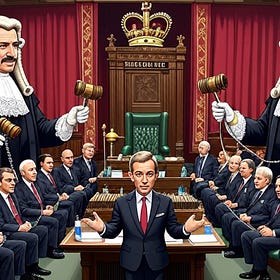
Parliamentary Sovereignty, imposed by the Victorian House of Lords, means elected governments are short term dictatorships, corruption incarnate. It’s time for constitutional representative democracy.Thanks for reading Knowledge is power! This post is public so feel free to share it.
Accountability For Lies By Elected Representatives and Candidates to Voters
·
Do we need new laws to make our elected representatives accountable? No. We have everything necessary. Part 1 of 3 : what avenues are available in the existing law? And why aren’t they being used?Thanks for reading Knowledge is power! This post is public so feel free to share it.
Holding Our Elected Representatives Accountable: Part 2a. A Legal Case For Accountability | Knowledge is Power
·
Here is one line of argument set out in legal documentation. Follows on from “Are NZ’s Elected Representatives “Allowed” To Lie To And Act Against Citizens?” (This has not been proofread or checked. It is simply a rough example, for future refinement.)
Holding Our Elected Representatives Accountable: Part 2b. Appeal, and public education pack| Knowledge is Power
·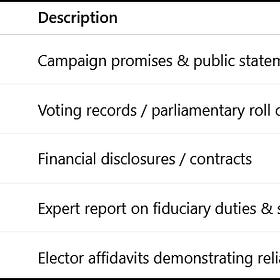
A ready-to-use “combined case bundle”
Are Our Elected Representatives "Allowed" To Lie To And Act Against Citizens? No. THAT Is A Lie. | Knowledge Is Power
·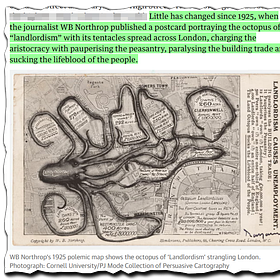
Why are our elected representative lying, acting against us, giving away our wealth, opportunities and resources? Some barons in the UK House of Lords gave THEMSELVES that power. It’s NOT our law!
The metamorphosis of Capitalism from a rejection of feudalism and rental, into encompassing it | Knowledge is Power
·
Capitalism evolved as a rejection of feudalism, based on rental, as an economic policy. It was based on exploitation of labour. Now it has come full circle, to include rental, and speculation.
and more .


Footnotes and further reading
Politicians in office can be immune from prosecution for criminal offences, through discretion of prosecution agencies, diversion to in-house procedures, or legislation; in some jurisdictions from bribery to rape. In cases of legislated immunity, politicians theoretically can be criminally prosecuted if the parliament strips them of immunity - but this has developed into a situation where the ruling party protects its own while in power, and parties often protect each other from liability. Thus we see extraordinary actions like the Polish Tusk Government recently appointing one of their own to the European Parliament - taking him out of prison where he was facing serious criminal charges.
Even where they are not exempt, the police don’t have to prosecute. And that discretion, likewise, is immune — unless a judge holds that a decision is “so fundamentally irrational that no reasonable authority could have possibly arrived at it“. In the US not even that challenge is available - with the extraordinary result that the current de facto director of the U.S. Immigration and Customs Enforcement (ICE) was not prosecuted despite being recorded accepting a bag containing $50,000 in cash in exchange for the promise of government contracts. In September 2025, the US Department of Justice closed the investigation, citing insufficient evidence. Some countries have Victims’ Right to Review legislation, but not New Zealand, and some allow “internal” review only.

Downloaded copy of RNZ video short - $1m buys an awful lot of advertising:
Problems with the Swiss referendums:
Switzerland is paralysed. Women didn’t even get the right to vote until the 1990s. 100 years after New Zealand. Gay marriage was not legalised until 2022. And corruption is entrenched and protected. Here’s how it works:
Swiss voters can proactively change federal law, but not through the veto referendum process. Once the 100-day window passes, a law is settled. To amend it or introduce a new rule after that, citizens must use a different tool: the Popular Initiative. While it cannot directly undo an existing statute retroactively, an initiative can create a new law or constitutional amendment that effectively supersedes or modifies the existing one. For example, voters might pass an initiative for a new tax, which necessitates amending the tax code they couldn’t stop before. it is a powerful, genuine tool used constantly—but the perception of how it is used, and how successful it is, requires nuance.
Regarding exposure, attempts cannot be officially suppressed, but they can be drowned out by moneyed interests. Switzerland relies on a system of “compulsory exposure” through institutional channels, rather than private media.
Here is a detailed breakdown of the realism, success, and transparency of the Swiss popular initiative.
Part 1: How Realistic Is It?
If “realistic” means “do citizens actually use this to change the Constitution?” the answer is yes, absolutely. It is not a decorative feature of the political system; it is the engine of the political agenda.
However, the definition of “success” for an initiative is complex.
1. The High Hurdle of Direct Success
The process is intentionally difficult. Organizers must collect 100,000 valid signatures (among approx. 5.6 million eligible voters) within 18 months. If they do, the issue goes to a nationwide vote. To pass, it requires a double majority: a majority of the popular vote and a majority of the cantons (states).
Because of these hurdles, and the conservative nature of the electorate, only about 10% of popular initiatives actually pass at the ballot box.
2. The Indirect Success (Where Direct Democracy Works)
If you only measure initiatives that pass on voting Sunday, the system looks unrealistic. However, the true realism is found in the indirect effects.
Even a failed initiative usually changes Swiss politics. Here is how:
The Counter-Proposal: If Parliament dislikes an initiative but agrees the problem is real, it will often draft a “counter-proposal.” This is usually a less radical law that addresses the same issue. Initiative organizers can then decide to withdraw their initiative in favor of the parliamentary counter-proposal.
Agenda Setting: Parliament and the Federal Council do not like uncertainty. Initiatives force them to deal with topics they would prefer to ignore. An initiative that receives 45% of the vote still sends a massive shockwave through Parliament, causing them to legislate on the topic in the following years to appease a nearly-majority electorate.
Mobilization and Party Building: Small parties or NGOs use initiatives to get free publicity for their causes and collect data on sympathetic voters, even if they know the initiative has no chance of passing.
The Verdict on Realism: It is highly realistic. It empowers outsiders to force the ruling coalition to the negotiating table. It is not a tool that bypasses the establishment entirely, but rather a tool that forces the establishment to compromise.
Part 2: Compulsory Exposure or Suppression?
Can powerful interests “hide” an initiative they don’t like? In the digital age and within the Swiss institutional framework, official suppression is virtually impossible. Compulsory exposure is built into the system.
1. Institutional Compulsory Exposure
The primary way Swiss voters learn about an initiative is not through private media, television ads, or billboards. It is through the “Federal Brochure” (colloquially the Abstimmungsbüchlein or “little voting book”).
This is institutional compulsory exposure. Every Swiss household receives, by mail, a booklet detailing every issue on the upcoming ballot.
The government is constitutionally required to include in this booklet:
The official text of the proposed initiative.
A balanced, neutral explanation of the issue.
The arguments for the initiative, written by the organizing committee.
The arguments against the initiative, written by the government and Parliament.
This booklet is trusted and read by millions. No matter how much powerful lobbyists hate an initiative, they cannot stop this booklet from arriving at the home of every citizen.
2. Pre-Acceptance Official Exposure
The collection of signatures is also public. Once an initiative committee launches an attempt, they must have the text reviewed and formally published in the Federal Gazette by the Federal Chancellery. From that moment, the clock starts, and everyone knows the initiative exists.
3. Real-World Exposure: The Role of Money
While the existence of an initiative cannot be suppressed, the debate around it can be dominated by money. This is where a more cynical “realism” enters the picture.
Switzerland historically had very loose campaign finance laws. Only recently (2022-2023) did new transparency rules come into force, requiring the disclosure of donations over CHF 15,000 for campaigns.
However, the economic elite still have a much louder voice. A well-funded “No” campaign (led by the business federation economiesuisse, for example) can saturate the country with billboards, print media ads, and sophisticated social media targeting. A grassroots committee of citizens may only have enough money to send their official booklet statement.
While this is not “suppression” in the sense of hiding something, it is the suppression of alternative viewpoints through sheer volume. Moneyed interests have a very high success rate in defeating initiatives that would harm corporate profits.
Summary: Ideal vs. Practice
The Swiss initiative is realistic because it is accessible, institutionalized, and guarantees that any group with enough organizational muscle can force a national debate and receive official space in the voting booklet.
It is imperfect because the final outcome of that debate is heavily influenced by who has the deepest pockets to shape public opinion leading up to the vote. Institutional mechanisms ensure attempts are exposed; private money determines how those attempts are perceived.

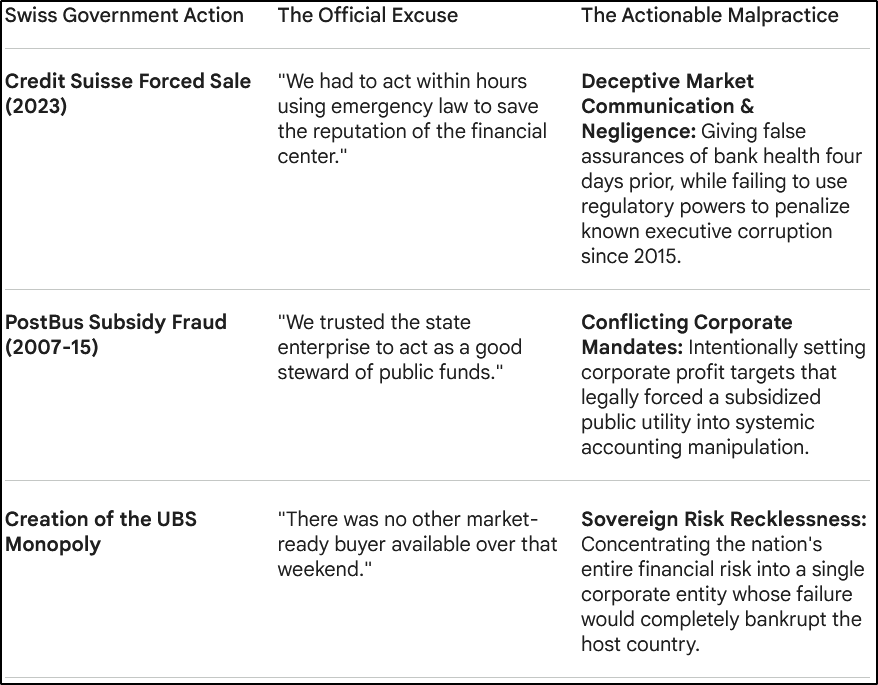
In recent Swiss political history, there are several glaring instances where federal authorities engaged in structural malpractice and could have been successfully sued by the citizenry.
1. The Credit Suisse Collapse and Forced Takeover (March 2023)
The handling of the Credit Suisse implosion is a textbook case of executive malpractice, regulatory capture, and the privatization of risk. Under a contract-based system, citizens, shareholders, and bondholders would have multiple actionable claims against the Federal Council and the financial regulator (FINMA).
The Actionable Breaches:
Fraudulent Misrepresentation to the Public: On Wednesday, March 15, 2023, the Swiss National Bank (SNB) and FINMA issued an unambiguous joint statement declaring that Credit Suisse was perfectly stable and met all hyper-capitalization requirements. Four days later, they reversed course, declared the bank would collapse by Monday, and forced a fire-sale to UBS. In a fiduciary court, these two actions cannot both be true. If the bank was healthy on Wednesday, forcing a low-value sale and wiping out $17 billion in AT1 bonds illegally destroyed investor assets. If it wasn’t healthy, the state lied to the public to manipulate the market—a clear breach of truth-enforcement.
Gross Negligence in Regulatory Oversight: The 569-page Parliamentary Investigation Committee (PUK) report published in late 2024 explicitly found that FINMA blundered for years. Regulators knew about Credit Suisse’s structural cultural rot, toxic risk-taking, and endless scandals dating back to 2015, yet “shied away” from enforcing penalties or banning bad actors. Failing to execute statutory oversight duties while a systemically vital bank rots constitutes severe professional malpractice.
Subversion of Legislative Due Process: The Federal Council utilized an emergency law loophole to bypass Parliament entirely, committing CHF 109 billion in taxpayer-backed liquidity guarantees behind closed doors. When Parliament convened for an extraordinary session and explicitly voted against the state guarantees twice, the Federal Council ignored the legislature entirely because a backroom committee had already rubber-stamped the funds. Bypassing the public’s representatives to bail out a corporate cartel is an actionable breach of contract.
2. The PostBus Subsidy Fraud Scandal (2007–2015)
The PostBus scandal shattered the illusion of flawless Swiss state management. PostBus, a subsidiary of the 100% government-owned Swiss Post, systematically falsified over 200,000 ledger entries—inventing fake expenses like undelivered bus tires—to illegally pocket CHF 205 million in federal and cantonal subsidies.
The Actionable Breaches:
Engineering a Structural Conflict of Interest: A parliamentary commission investigation explicitly found the Federal Council responsible for “deficiencies” in oversight. The Council had issued fundamentally conflicting mandates: they legally ordered the parent company (Swiss Post) to maximize corporate profits as a group, while simultaneously enforcing a strict legal ban on the regional transport unit (PostBus) from turning a profit. The executive branch effectively engineered a legal trap that heavily incentivized accounting fraud to balance the state’s own contradictory books.
Condoning the Abdication of Asset Audits: Despite clear warnings from the price regulator as early as 2012 questioning PostBus’s unusual numbers, the Federal Council failed to audit the funds. Even worse, after the scandal broke, the Federal Council officially rejected demands from a parliamentary commission to set up an independent supervisory body to monitor state-owned monopolies (like Swisscom and Swiss Federal Railways), choosing instead to protect the existing, opaque management framework. Under a fiduciary model, a director who refuses to implement standard compliance after a multi-million dollar fraud is personally liable for ongoing asset exposure.
3. The Uncapped Liability of the UBS Hyper-Monopoly
By forcing the Credit Suisse merger, the Federal Council single-handedly created an economic leviathan: a single Swiss bank whose balance sheet is roughly double the entire GDP of Switzerland.
The Actionable Breach:
Gross Endangerment of Sovereign Assets: Under corporate and fiduciary law, a board of directors cannot place the entire entity’s survival on a single, un-hedged risk. By creating a banking monopoly “too big to fail” and too massive for the Swiss state to realistically bail out if a global systemic crisis hits, the Federal Council breached its foundational duty of asset protection. They converted a localized banking failure into a permanent, existential threat to the sovereign solvency of the Swiss taxpayer.
Liability Summary Matrix

It didn’t happen in the Athenian state. And the growth of tyranny since then is such that there have been no democracies without immunity since the Athenian state. It was a unique occurrence in the history of the world, set up under the influence of the Greek philosophers.
There were also powerful “whistleblower” and other protections, concomitant with that personal liability. Rather than go along with bad decisions or avoidance of decisions and incur personal liabilities, the Athenians had a sophisticated system of denunciation. Which actually enabled public review of contentious decisions before they were made, and of lack of preparation for events before they occurred. Public consultation and mandate negated personal liability.
The smokescreen of “commercial sensitivity” is replaced by publicly opened tenders on clear precise specifications.
The actual data shows that humanity is an overwhelmingly cooperative, pro-social species. The vast majority of people—98%—just want a calm, harmonious life. They don’t steal from their coworkers, they don’t break into their neighbors’ houses, and hate-driven malice is a microscopic anomaly—which would be even further reduced by the removal of need in the form of poverty and hardship.
But if the public ever realized that their baseline nature is cooperative and self-regulating, the entire justification for political immunity evaporates. The state would no longer be viewed as a necessary shield protecting society from chaos; it would be exposed for what it is under the current meta: a legal fortress for the extraction of wealth.
Putting these two concepts side by side blows the lid off the entire philosophical defence of the modern state. It shows that “representative” sovereignty isn’t a rational evolution of governance—it’s just old-school authoritarian control dressed up in secular vocabulary.
Ironically, the exact Glasnost (transparency/openness) and Perestroika (restructuring/functionality) that USSR’s last President Mikhail Gorbachev diagnosed as essential to patch the USSR’s failing, opaque, and top-down bureaucratic empire. (Sadly, the US blocked funding to allow the project to continue, and ensured Russia never got near it. The reader can speculate why.)
But when you map those concepts onto a true fiduciary contract, they transform from mere political slogans into hard, enforceable system requirements:
Glasnost (Transparent): Total institutional openness becomes the administrator’s primary legal shield. If you hide the data, hide the expert warnings, or hide the donor meetings, you are committing a criminal breach of contract. Openness is no longer a choice; it’s the environment, that protects everyone and enables informed decisions.
Perestroika (Functional): The structural mechanics of the state are fundamentally re-engineered. You strip away the artificial immunity shields, meaning the system can no longer be used as a playground for extraction cartels. The architecture is forced to function efficiently because the people running it carry 100% of the personal liability if it fails.
By demanding a transparent, functional environment, you are essentially launching a systemic patch that forces the state to work for the 98%.
Examples of judicial legislation of permission to lie and break promises:
1. United States: O’Reilly v. Mitchel (1914)
In this foundational case, a group of voters sued New York City Mayor John Purroy Mitchel, seeking an injunction to stop him from violating explicit pledges he made during his election campaign.
The Ruling: The Supreme Court of New York dismissed the lawsuit. The court held that a campaign promise does not create a contract, a tenancy, or a legally cognizable relationship between the candidate and the voter.
The Justification: The judiciary ruled that campaign platforms are purely “moral obligations”. To make them legally binding would paralyze governance, meaning the only permissible recourse for a defrauded public is the ballot box.
2. United Kingdom: R (Wheeler) v. Office of the Prime Minister (2008)
The Labour Party won the 2005 general election on an explicit manifesto promise to hold a public referendum before ratifying the European Constitution (which became the Lisbon Treaty). Once in power, Prime Minister Gordon Brown reneged and ratified the treaty via Parliament without a public vote. Citizens sought a judicial review to force the government to hold the promised referendum.
The Ruling: The High Court of England and Wales flatly rejected the challenge.
The Justification: The court ruled that political party manifestos and campaign promises are documents of political intent, not contracts. The judiciary declared that it has no jurisdiction to enforce political promises made to the electorate, as doing so would breach the separation of powers and inappropriately draw the courts into political warfare. Accountability for a broken manifesto promise belongs strictly to Parliament and subsequent elections.
3. Canada: Help BC cases v British Columbia NDP MLAs (2008)
Backed by the National Citizens Coalition, voters brought charges against three elected New Democratic Party (NDP) Members of the Legislative Assembly (MLAs) in British Columbia. The plaintiffs argued that the politicians - particularly Premier Glen Clark and Finance Minister Elizabeth Cull - had systematically lied during the election campaign to trick voters that the government had balanced the previous budget (which turned out to be untrue) and “would do the same if re-elected”, constituting civil fraud and a breach of a public undertaking.
The Ruling: The British Columbia Supreme Court dismissed the case and exonerated the politicians.
The Justification: The court affirmed that statements made on the campaign trail cannot be interpreted as concrete legal “undertakings” or actionable contracts. The judge noted that the adversarial nature of representative elections assumes a environment of political salesmanship, and the legal system cannot penalize a politician for shifting policies once they assume office.
This post will never be shown in search results, because of its political content.
Please share it, and tell me what you think.
You can also contact me on https://bsky.app/profile/talaria-fyi.bsky.social.
Enjoy.