

A brief history of the 10 information technology revolutions, how they empowered ordinary people to govern ourselves. And the battle to stop us.
AI note: This is not “94% AI” - I think AI mistakes my style for AI. I’ll take that as a compliment 😎. The concept, research, structure and thesis are entirely my own and the information portrayed here is fact checked. I spent considerable time instructing AI to refine my draft to exactly what I wanted, then the final has been substantially rewritten by me and added to manually.

Overview and Core Thesis
This follows on from

“The Tools of Control” examines the historical, technological, and political tension between information democratisation (empowering ordinary people to achieve self-determination) and centralised authoritarian capture (efforts by states, oligarchs, and institutions to claw back that control).
How did the information revolutions work?
No one seems to realise that the later information revolutions completely removed the old elitist chestnuts of “mob rule” and “tyranny of the majority” — phrases used by a power-hungry minority to dehumanise and disenfranchise everyone else. Through cruelty and violence the few kept everyone else ignorant and poor. In today’s world, what they did are crimes. Theft, slavery etc.
In mediaeval England the privileged few were called “Lords”. Now they are called less flattering names, like the “Epstein Class”. Of course ordinary people were ignorant historically — because information was deliberately withheld from them, and they were forced to spend their whole lives working to enrich the Lords, or later - selling their work to survive in abject poverty.
Now, school children know more than those Lords did. They thought the earth was flat and the sun travelled around us, they had no knowledge of maths, genetics, chemistry, medicine, economics, climate or democracy. Yet they are still seen as entitled to rule.
The “ignorance” excuse was gone, generations ago. We now know that the only real dividing line is opportunity.
The central thread running through the history below is that information revolutions are dual-use systems. The cumulative leaps in communication technology—from the printing press to the internet—initially shatter existing monopolies on truth and power, allowing ordinary people to mobilise and exercise self-determination. However power-holders invariably try to limit public access, and to use the tools to disempower the public and retain power for themselves.
Key Historical Arc: The Information Revolutions
History traces this recurring cycle across several major eras:
1. The Print Revolution and the Dissolution of Divine Right
The Liberation: Johannes Gutenberg’s movable-type press broke the Catholic Church and feudal monarchies’ absolute monopoly on literacy, scripture, and law. It fuelled the Protestant Reformation, the scientific revolution, and early modern democratic thought by allowing decentralised pamphlet-sharing.
The Control: Authorities countered with the Index Librorum Prohibitorum (List of Prohibited Books), state licensing of presses, severe libel and sedition laws, and public book burnings to reassert narrative dominance.
2. The Mass Media Era and the Rise of Propaganda
The Liberation: The rise of cheap newspapers, the telegraph, and radio expanded the public sphere, making political awareness and engagement a mass phenomenon and accelerating labour rights and anti-colonial movements.
The Control: Recognising that blunt censorship was less effective in mass societies, power-holders and the people’s own elected governments that they controlled, developed systematic propaganda. This era saw the institutionalisation of public relations and psychological management (pioneered by figures like Edward Bernays), turning information technology into a tool for manufacturing consent and managing public behaviour from above.
3. The Digital Age, the Internet, and the Decentralised Promise
The Liberation: The advent of the internet, personal computing, and cryptographic tools promised the ultimate democratisation of information. Power was decentralised, allowing peer-to-peer networks to bypass legacy media gates, coordinate flash-mobs, and launch transnational whistleblower and human rights campaigns.
The Control: The contemporary battleground. Modern states controlled by surveillance-capitalist oligopolies have weaponised the very same infrastructure. Through algorithmic curation, micro-targeting, digital ID tracking, state-sponsored content moderation, and dragnet metadata collection, digital tools have transformed from instruments of liberation into the most sophisticated systems of behavioural control and pre-emptive censorship in human history.
The Modern Battleground: Digital Feudalism vs. Digital Self-Determination
In the contemporary context, the conflict focuses on a few critical fronts:
Algorithmic Enclosures: Moving away from the open web toward walled-garden platforms where engagement algorithms prioritise outrage, division, and compliance over free association and education.
Infrastructure Choke-points: The privatisation of digital public squares, where cloud providers, payment processors, and domain registrars can instantly silence decentralised movements or alternative voices.
Surveillance State Expansion: The normalisation of biometric tracking, predictive policing algorithms, and financial tracking (such as CBDCs—Central Bank Digital Currencies) that threaten to render dissent economically and socially impossible.
Conclusion
The overarching message of “The Tools of Control” is that the public availability of information is the sole thing that has given us self-determination, the power to self govern and thereby our lives and liberty.
But while information can break open a closed system, it requires simple political and structural protections to protect our access to it, from the institutional drive to cut it off and re-monopolise information. The final battle is not just about what information is allowed to flow, but who controls and designs the infrastructure of information availability and human communication.
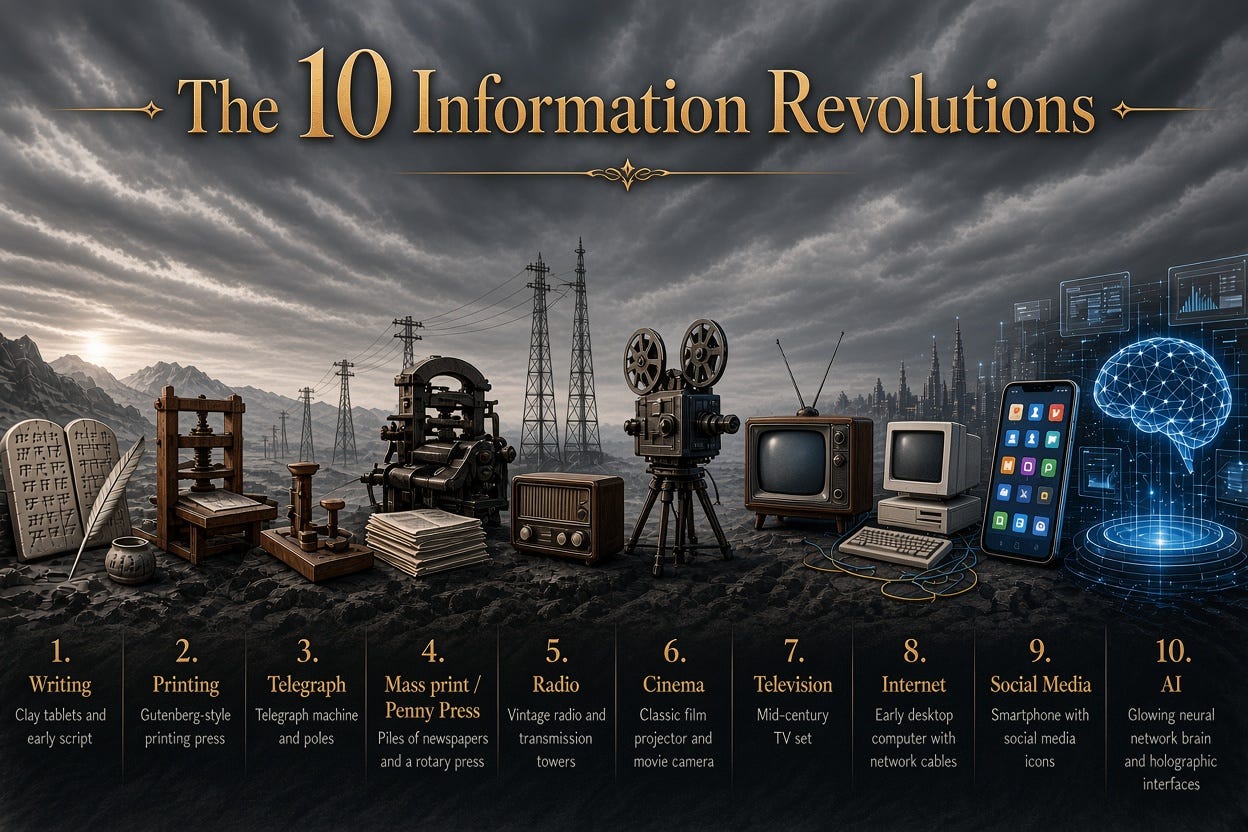
The 10 information revolutions - a concise history and analysis
1. Writing (c. 3200 BCE)
Effect on Knowledge and Analysis Skills: Constricted analytical capacity to a narrow administrative and clerical class; trained the human mind in codified, rule-bound categorisation, legal permanence, and hierarchical tracking while leaving the general population dependent on oral tradition and external authority for interpretation.
Thinking: Shifted human cognition from ephemeral oral memory to objective, externalised storage. Enabled abstract thought, long-term planning, and standardised codification of knowledge.
Thinking & Autonomy: Established externalised storage, but deeply restricted autonomy. Because literacy was isolated to scribal and priestly classes, the general population gained no resources to question what they were told by power-holders.
Political Power: Concentrated power exclusively in the hands of literate elites (scribes and priesthoods). Knowledge became a guarded commodity used to legitimise divine right and elite rule.
Political Structure: Record-keeping enabled the transition from tribal chieftainships to large-scale, centralised bureaucratic states and empires (such as ancient Mesopotamia and Egypt) with tax collection, legal codes (e.g., Code of Hammurabi), and administrative tracking. Enforced hierarchical compliance; law codes and royal decrees were handed down top-down as unquestionable edicts, anchoring early centralised bureaucratic states.
Who Accessed Information & Spread: Access was strictly confined to an ultra-narrow group of specialised scribes, priests, and ruling monarchs. The non-literate majority had zero direct access to written texts; information reached them exclusively through oral repetition, royal proclamations, temple rituals, and the interpretations of local authorities. Access was tightly restricted by the physical scarcity of materials and the deliberate withholding of literacy as an instrument of control.
Non-Authority Sources, Censorship, & Criticism: Independent commentary was virtually non-existent in formal archives, though subversive oral folklore, satirical street plays, and anonymous graffiti served as early underground channels. State and religious authorities maintained strict censorship by physically destroying dissenting texts and executing heretics or critics, ensuring that written records remained entirely subservient to power.
2. Printing (c. 1440)
Effect on Knowledge and Analysis Skills: Catalysed the rise of vernacular (the local language, as opposed to languages used by the aristocracy and religious elites, that ordinary people did not understand) literacy, shifting population-wide cognitive patterns toward independent thinking, linear text analysis, comparative scepticism, and individual textual interpretation.
Thinking: Fractured the monopoly of the Church and scholastic authorities. Sparked a rise in vernacular literacy, individual critical interpretation, and the democratisation of scepticism.
Thinking & Autonomy: Sparked the first major leap in individual independent thinking, and awareness of information as an objective constant. By enabling common language text duplication, limited members of the nobility, religious, merchant and artisan classes could read scripture, law, and philosophy independently, breaking the monopoly of institutional arbiters.
Political Power: Disrupted the centralised control of information by monarchs and the clergy. Allowed opposition movements to bypass institutional gatekeepers and rally public opinion. Ultimately triggered the breakaway of the aristocracy and changes in the political power balance and, much later, with the assistance of the Black Plague, the end of serfdom (where people were considered as part of the land) and the beginnings of limited mobility and paid labour.
Political Structure: Fuelled the Protestant Reformation, the Scientific Revolution, and the Enlightenment. Paved the way for the rise of the nation-state, as vernacular printing standardised regional dialects into national languages and unified populations under shared cultural identities. Disrupted clerical and monarchical control, fuelling the Reformation and empowering citizens to question divine right, laying the groundwork for early republican thought.
Who Accessed Information & Spread: Initially restricted to the educated clergy, nobility, and the rising merchant class. For centuries, extreme poverty, long manual labour hours, and structural illiteracy excluded the rural peasantry and urban working poor from direct text consumption. Information trickled down through public readings in taverns, cheap broadsheets, and sermons. Access barriers were primarily economic and educational, maintained by high production costs and restricted schooling.
Non-Authority Sources, Censorship, & Criticism: The printing press birthed the first true independent commentary and satire. Pamphleteers, essayists, and philosophers (such as those during the Enlightenment) weaponised print to launch scathing critiques of absolute monarchs and the Church. In response, states established rigid licensing laws and censorship boards (e.g., the Index Librorum Prohibitorum). This cat-and-mouse dynamic created the modern concept of a “free press” fighting against state suppression.
3. The Telegraph (c. 1830s–1840s)
Effect on Knowledge and Analysis Skills: Shifted public and institutional mental processing from deep, reflective historical context to rapid, fragment-based awareness, prioritising immediacy over long-form analysis.
Thinking: Redefined human perception of space and time. Accelerated the pace of decision-making and created a synchronised, real-time awareness of distant events.
Thinking & Autonomy: Compressed space and time, but initially centralised decision-making autonomy rather than distributing it. Field commanders and local actors lost independent discretion because central capitals could monitor and micromanage operations in real time.
Political Power: Centralised political and military command. Central governments and colonial empires could instantly direct distant armies, governors, and diplomatic corps from the capital.
Political Structure: Enabled the efficient administration of vast, sprawling nation-states and global empires. It also concentrated economic power, giving rise to national financial markets and corporate monopolies that required coordinated, long-distance logistics. Strengthened the central apparatus of the nation-state and corporate monopolies, allowing rapid coordination of logistics, military suppression, and standardised administration.
Who Accessed Information & Spread: Primarily utilised by state actors, military commanders, corporate executives, and newspaper wire services. Access was heavily restricted by the immense capital cost of laying infrastructure and operating lines. The general public did not access telegraph machinery directly; instead, they consumed downstream results published in newspapers hours or days later. Later, through telephones, communication was made much easier, wider and (somewhat) more private.
Non-Authority Sources, Censorship, & Criticism: Because telegraph networks were capital-intensive and often state-regulated or monopolised by corporate syndicates, independent or critical voices struggled to use the technology directly. However, wire-service journalism enabled reporters in the field to file independent accounts that occasionally bypassed official military or government spin, laying the foundation for independent war correspondence and investigative reporting.
4. Mass Print / The Penny Press (c. 1830s–1890s)
Effect on Knowledge and Analysis Skills: Conditioned the working and middle classes to process daily current events, evaluate competing journalistic perspectives, and engage in regular, structured civic discourse as a habit of daily life.
Thinking: Cultivated a shared daily consciousness among the working and middle classes. Fostered widespread political awareness, civic engagement, and the concept of public opinion as a political force.
Thinking & Autonomy: Cultivated a literate working class capable of collective political reasoning. Individuals transitioned from isolated subjects to active participants who could compare different editorial viewpoints.
Political Power: Shifted power toward the urban masses and organised political parties, who could now be mobilised en masse through newspapers, editorials, and cheap pamphlets.
Political Structure: Accelerated the transition toward mass democratic politics and representative governance. Governments could no longer govern in isolation; they had to actively manage public relations, electoral campaigns, and the demands of an electorate that consumed daily news. Forced governments to contend with organised public opinion. Political parties had to persuade rather than merely command, driving the expansion of mass democratic franchise.
Who Accessed Information & Spread: Accessible to the broad urban working and middle classes, driven by cheap wood-pulp paper and the gradual introduction of compulsory public education. However, during the early-to-mid Victorian era, extreme poverty and gruelling 14-hour workdays for the industrial poor meant that physical exhaustion and lack of leisure remained massive barriers to active political analysis, until labour movements and educational reforms systematically expanded true mass accessibility.
Non-Authority Sources, Censorship, & Criticism: This era saw a vibrant explosion of independent, radical, and labour-union press alongside commercial newspapers. Working-class publications, political satire magazines (such as Punch), and investigative muckrakers criticised industrial exploitation and government corruption. While states occasionally used libel laws and sedition acts to suppress radical pamphleteers, the sheer volume of competing independent publications made total censorship nearly impossible in liberal democracies.
5. Radio (c. 1920s)
Effect on Knowledge and Analysis Skills: Tuned public cognition toward emotional resonance, tribal identification, and auditory suggestibility, often bypassing deep text-based skepticism in favour of immediate, immersive persuasion.
Thinking: Shifted cognitive processing from text-based analysis to emotional, auditory resonance. Bypassed literacy barriers, uniting diverse demographics under a singular, synchronous acoustic experience.
Thinking & Autonomy: Paradoxically, radio introduced a deep vulnerability to mass psychological suggestion and emotional conformity. By bypassing print-based critical analysis through direct acoustic immersion, it created fertile ground for authoritarian obedience and charismatic demagoguery (e.g., 1930s totalitarian states).
Political Power: Concentrated unprecedented persuasive power in the executive branch and charismatic national leaders, who could bypass parliaments and journalists to speak directly into every citizen’s home.
Political Structure: Fuelled the rise of 20th-century mass political movements, populist demagoguery, and totalitarian regimes (e.g., Nazi Germany, Fascist Italy, and the New Deal administration in the US). It centralised state authority by turning fragmented local populations into synchronised national audiences. Concentrated totalising propaganda power in the executive branch, synchronising entire populations into uniform national mindsets.
Who Accessed Information & Spread: Highly accessible across all demographics simultaneously because it entirely bypassed literacy barriers and reached into the domestic living space. While state monopolies in totalitarian regimes heavily restricted access to alternative viewpoints by criminalising foreign broadcasts, democratic nations allowed wider public access through commercial networks and public service broadcasters.
Non-Authority Sources, Censorship, & Criticism: Radio was a double-edged sword. While authoritarian regimes used state monopolies to broadcast unfiltered propaganda and criminalise listening to foreign stations (like the BBC in Nazi Germany), democratic nations developed independent public-broadcasting models or commercial networks that fostered investigative journalism, political satire, and independent commentary. Underground pirate radio stations also emerged as crucial tools for resistance fighters and political dissidents.
6. Cinema (c. 1895–1910s)
Effect on Knowledge and Analysis Skills: Trained popular consciousness to interpret complex social, moral, and political concepts through visual metaphors, cinematic pacing, and emotional empathy rather than abstract intellectual debate.
Thinking: Grounded political and cultural ideologies in powerful visual iconography and narrative myth-making. Fostered shared cultural archetypes and emotional empathy across class lines.
Thinking & Autonomy: Engaged collective emotional archetypes and visual empathy. While capable of fostering profound cultural alignment, it was heavily leveraged for state myth-making and wartime psychological mobilisation.
Political Power: Provided states and political movements with an unmatched instrument for cultural hegemony, psychological conditioning, and national myth-building.
Political Structure: Integrated mass entertainment with statecraft. Totalitarian regimes weaponised film for overt ideological indoctrination, while liberal democracies utilised Hollywood and state film boards to foster patriotism and mobilise populations during crises (such as World War II). Enabled governments to manufacture national consensus and patriotic fervour through immersive, shared visual narratives.
Who Accessed Information & Spread: Universally accessible to the broad masses—working-class populations, immigrants, and the illiterate alike—who flooded nickelodeons and grand movie palaces. Because information and narrative were conveyed through universal visual language and moving images, literacy played no role in consumption, though access was shaped by ticket pricing, urban distribution, and strict state or studio censorship boards that restricted the physical screening of unsanctioned political films.
Non-Authority Sources, Censorship, & Criticism: Cinema was never exclusively a tool of state control; it nurtured powerful independent, avant-garde, and satirical counter-cultures. Filmmakers used documentaries, satirical fiction (such as Charlie Chaplin’s The Great Dictator), and international art-house cinema to critique fascism, militarism, and social inequality. Governments fought back with strict studio self-censorship (like the Hollywood Production Code) and state boards of censors to suppress political dissent and subversion.
7. Television (c. 1940s–1950s)
Effect on Knowledge and Analysis Skills: Encouraged a visual, aesthetic evaluation of leadership and events (”sight-bite culture”), shifting populations from reading abstract policy arguments to reacting to immediate, visceral televised imagery.
Thinking: Immersed populations in an instantaneous, highly visual, and emotional reality. Reduced complex policy debates into immediate, aesthetic impressions (”sight-bite” culture).
Thinking & Autonomy: This era marked the ultimate clash between state-managed compliance and information-driven autonomy. As seen sharply during the Vietnam War, television brought unscripted, graphic realities (such as the Tet Offensive and civilian casualties) directly into the living room.
Political Power: Transformed political power into a televised performance. Success depended increasingly on media coaching, visual appeal, and the management of televised optics over deep policy formulation.
Political Structure: Centralised national political discourse while simultaneously eroding trust in traditional institutions. Landmark televised events (such as the Kennedy-Nixon debates, the Vietnam War, and the Civil Rights movement) bypassed traditional political filters, directly shaping policy outcomes and forcing governments to react to real-time visual pressure. For centuries, states expected Spartan-like blind obedience during wartime based on official briefings. Television shattered this: when the visual data provided by the media sharply contradicted government claims, it triggered a massive crisis of institutional trust, fuelling widespread civil disobedience, anti-war rebellions, and forcing policymakers to alter or abandon strategic objectives under direct public pressure.
Who Accessed Information & Spread: Universally accessible across all households within developed nations, requiring no literacy or specialised skills. It functioned as an ambient, shared hearth, instantly equalising access across classes, ages, and educational backgrounds, though access remained strictly gated by the central programming schedules and editorial boards of national networks or state-run broadcasting authorities.
Non-Authority Sources, Censorship, & Criticism: Television created a massive arena for independent analysis, investigative journalism, and biting satire. Programs like See It Now (challenging McCarthyism), televised anti-war documentaries, and late-night satirical news commentary provided citizens with powerful counter-narratives that actively dismantled official government spin. While authoritarian states maintained absolute state control over television networks, Western democracies saw independent journalists and documentary filmmakers act as an adversarial “Fourth Estate,” directly challenging political authority and fuelling mass civic rebellions like the anti-Vietnam War movement.
8. The Internet (c. 1960s–1990s)
Effect on Knowledge and Analysis Skills: Transitioned cognitive habits from linear, hierarchical processing to non-linear, hyperlinked information foraging, fostering rapid cross-referencing capabilities alongside a growing tolerance for fragmented information.
Thinking: Shifted thinking from hierarchical, linear information consumption to networked, hyperlinked, and non-linear inquiry. Created an expectation of infinite, frictionless access to global data.
Thinking & Autonomy: Decentralised epistemic authority entirely. Individuals gained the tools to bypass official state or corporate filters, cross-reference data globally, and construct independent worldviews.
Political Power: Decentralised information control, stripping traditional gatekeepers (governments, legacy media, academic boards) of their absolute monopoly on truth and distribution.
Political Structure: Empowered decentralised networks, non-state actors, and international civil society. While initially heralded as a democratising force that could outmanoeuvre authoritarian censorship, it later exposed states to new vulnerabilities, including cyberwarfare, state-sponsored disinformation, and the erosion of national information borders. Disempowered traditional gatekeepers. Enabled frictionless coordination among non-state actors, dissidents, and global civil society, while simultaneously exposing state actors to cyber-disruption and asymmetrical intelligence leaks.
Who Accessed Information & Spread: Initially restricted to academic researchers, military engineers, and technical elites in the 1960s–1980s, expanding rapidly to the global public via the World Wide Web in the 1990s. Information spread instantly via digital networks, bypassing physical distribution barriers entirely and enabling anyone with terminal access to retrieve global data, though early access remained gated by hardware costs and digital literacy divides.
Non-Authority Sources, Censorship, & Criticism: The early internet was fundamentally built on non-authority sources: independent blogs, whistleblowing archives, open-source forums, and counter-cultural analysis platforms. It allowed individuals to bypass mainstream media editorial filters completely. Authoritarian states attempted traditional censorship through digital “firewalls,” while democratic states faced new battles over digital copyright, surveillance, and the regulation of independent political commentary.
Aaron Swartz’s fight to democratise the Internet — 1 small episode of the war for self-determination (2.5 hours)
9. Social Media Platforms (c. 2000s–Present)
Effect on Knowledge and Analysis Skills: Accelerated short-form, emotional pattern recognition and hyper-reactive engagement loops, eroding deep attention spans and contextual analysis in favour of tribal alignment and algorithmic outrage triggers.
Thinking: Accelerated affective polarisation, outrage loops, and tribal epistemology. Replaced shared factual baselines with hyper-personalised algorithmic echo chambers where attention economy metrics dictate truth.
Thinking & Autonomy: Created a complex paradox of hyper-autonomy and automated control. While every individual possesses the publishing power to instigate global movements (e.g., leaderless uprisings), cognitive decision-making is heavily influenced by algorithmic echo chambers and affective polarisation.
Political Power: Distributed publishing power to every individual citizen while concentrating ultimate structural and regulatory power in the hands of private, multinational tech monopolies that control the algorithms.
Political Structure: Upended traditional political parties and electoral strategies. Enabled rapid, leaderless mass mobilisations (e.g., Arab Spring, populist movements globally) but also facilitated state-backed surveillance, micro-targeted behavioural manipulation, democratic backsliding, and the destabilisation of institutional trust. Empowered rapid, bottom-up mass resistance against regimes, but also provided authoritarian and democratic states alike with unprecedented tools for digital surveillance, micro-targeted behavioural manipulation, and information warfare.
Who Accessed Information & Spread: Universally accessible to anyone with a smartphone or internet-connected device across global demographics. However, access is no longer merely constrained by physical poverty or technical exclusion; rather, it is actively distorted by deliberate information pollution. Bad-faith state actors, corporate astroturfing campaigns, bot networks, and troll farms weaponise the “fire-hose of falsehood” to flood networks with contradictory noise. This pollution is a calculated strategy designed to inflict cognitive exhaustion, forcing citizens to retreat into apathy, cynicism, and disengagement because the cost of filtering truth from weaponised noise has been made punishingly high.
Non-Authority Sources, Censorship, & Criticism: While social media platforms give voice to independent creators, citizen journalists, and grass-roots critics, the landscape is heavily contested by industrial-scale manipulation, state-backed astroturfing, and automated amplification bots. Traditional censorship has mutated into algorithmic content moderation, shadow-banning, and platform-level restrictions, creating an ongoing battleground where open peer-to-peer critique is constantly undermined by engineered chaos designed to neutralise public resistance.
10. Artificial Intelligence (c. 2020s–Present)
Effect on Knowledge and Analysis Skills: Outsources the synthesis, filtering, and drafting of information to algorithmic agents, risking the atrophy of human critical synthesis, deep reading endurance, and independent factual verification if used as a substitute for thought rather than a tool.
Thinking: Shifts cognitive processing from direct information retrieval and human-led analysis to prompt-based orchestration and synthetic generation, creating a reality where synthesised answers are delivered instantly without the user navigating the underlying source material.
Thinking & Autonomy: Introduces a profound dual-use paradox for individual autonomy. On one hand, it democratises advanced coding, legal drafting, and data analysis for everyday citizens; on the other, it threatens to erode human agency through hyper-personalised synthetic persuasion, automated behavioural shaping, and deepfakes that fabricate false consensus at scale.
Political Power: Concentrated massively in the hands of a tiny oligopoly of multinational tech conglomerates and heavily resourced state actors who control the immense compute clusters, proprietary data pipelines, and foundational models required to build and deploy advanced AI.
Political Structure: Upends traditional institutional structures by automating bureaucratic processing, intelligence gathering, and mass public relations. Enables authoritarian states to achieve total, frictionless population surveillance and predictive policing, while destabilising democratic governance through industrial-scale synthetic propaganda, automated electoral manipulation, and the collapse of shared objective reality.
Who Accessed Information & Spread: Accessible globally to anyone with a smartphone, web browser, or API connection, radically lowering the technical barriers to generating complex text, code, and imagery. However, true equity of access is heavily restricted by corporate paywalls, entry barriers to competition (“computational gatekeeping”), and authorities and tech monopolies dictate the foundational "rules of thought"—deciding what an AI is permitted to know, how it processes information, and what biases or boundaries are hardwired into its core.. Furthermore, access is actively degraded by algorithmic information pollution—where viewer data scraping and AI tools are weaponised by bad actors to automatically generate hyper-targeted disinformation, fake feedback, and deepfake media, drowning genuine material and manipulating perception. Making verification of every assertion punishingly expensive for professional journalists and media, and impossible for the public.
Non-Authority Sources, Censorship, & Criticism: AI platforms serve as both a revolutionary vehicle for independent critique (allowing independent analysts to process massive leaked datasets or translate complex institutional documents in seconds) and an unprecedented instrument for automated, invisible censorship. Corporations and states embed algorithmic guardrails, automated content filters, and prompt-injection defences that censor dissent under the guise of “safety” and “moderation,” while automated bot swarms pollute public discourse to drown out independent analysis.
Further reading:
Why
How to ensure public access to real information… Control of our governments is the essential starting point!


Real nice chorological flow of how information "services" have developed along side with us. And good to note that each and every single one was used for good and bad. Maybe the problem isn't just the tech... maybe... its us.